Many construction professionals view procurement as a support function responsible for purchasing materials and equipment.
In reality, procurement decisions made months, and sometimes years, before construction begins often determine whether a project will finish on time, within budget, and without major disruptions.
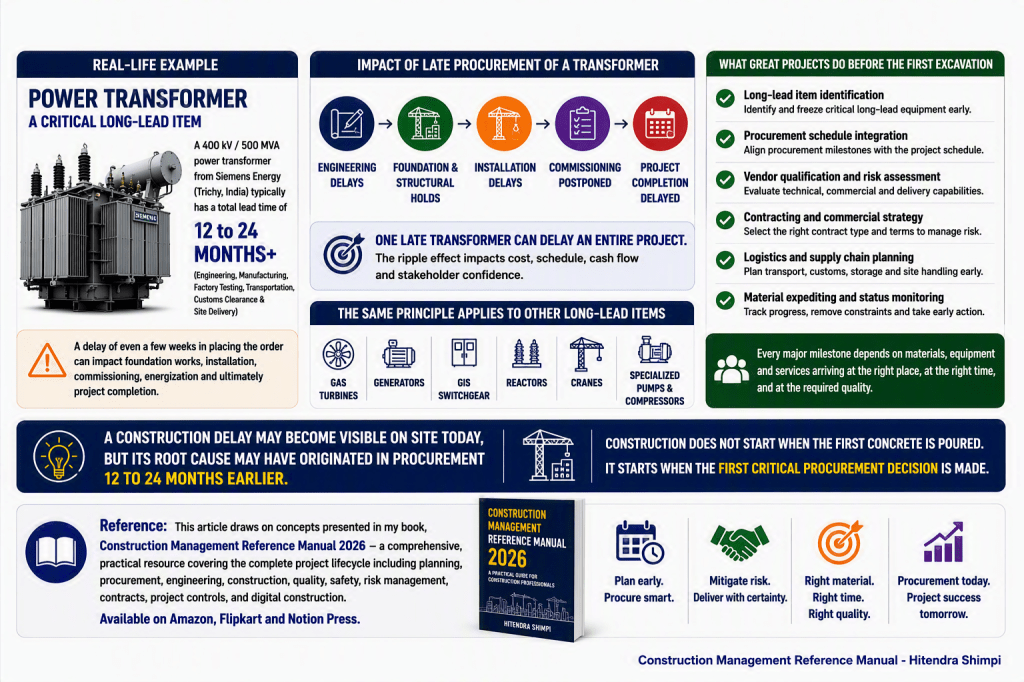
Consider a large power transmission project. A 400 kV or 765 kV power transformer is often one of the project’s critical long-lead items. From engineering, manufacturing, factory acceptance testing (FAT), transportation, customs clearance, and site delivery, the total lead time can extend well beyond a year, and in some market conditions even longer.
If the transformer order is delayed by just a few weeks, the impact can ripple through foundation works, substation construction, installation, testing, commissioning, energization, and ultimately project completion. By the time construction teams realize there is a procurement problem, recovery options are often expensive and limited.
The same principle applies to:
- Gas turbines
- Generators
- GIS switchgear
- Reactors
- Cranes
- Specialized pumps and compressors
Successful projects treat procurement as a strategic project control function rather than simply a purchasing activity.
Before the first excavation begins, project teams should focus on:
✅ Long-lead item identification
✅ Procurement schedule integration with the project schedule
✅ Vendor qualification and risk assessment
✅ Contracting and commercial strategy
✅ Logistics and supply chain planning
✅ Material expediting and status monitoring
The best construction managers understand that every major milestone depends on materials, equipment, and services arriving at the right place, at the right time, and at the required quality.
A construction delay may become visible on site today, but its root cause may have originated in procurement 12 to 24 months earlier.
Construction does not start when the first concrete is poured. It starts when the first critical procurement decision is made.
In your experience, what has caused more project delays?
A) Construction execution issues
B) Procurement and supply chain issues
📘 Reference: This article draws on concepts presented in my book, Construction Management Reference Manual 2026 – a comprehensive, practical resource covering the complete construction project lifecycle, including planning, procurement, engineering, construction, project controls, quality, safety, risk management, contracts, commissioning, and digital construction. The book is available on Amazon, Flipkart, and Notion Press.
 hitendrashimpi44-gxtby
Leave a comment